Tuesday, 18 October 2016

Relate North 2016

The 2016 Relate North conference is taking place in Shetland from 8-11 November. For details and registration see the ASAD website.  

The symposium and art exhibition will bring together  artists, educators and researchers from across the Arctic Fringe to explore ways in which art, innovation and creativity can help build sustainable communities in the North. It's exciting to host it in Shetland - previous Relate North conferences have been held in Anchorage, Alaska (2015); in Kautokeino, Norway (2014); in Reykjavik, Iceland (2013) and in Rovaniemi, Finland (2012).
 
This year’s theme, Practising Place: Art & Design for Creative Communities, brings together internationally-renowned contemporary artists and designers, art educators, ethnographers and cultural historians. The event, a collaboration between the Arctic Thematic Network on Arctic Sustainable Arts and Design (ASAD), the University of the Highlands and Islands and the University of Lapland, will include representatives from many of the eight countries of ASAD – Scotland, Canada, Finland, Iceland, Norway, Russia, Sweden and the United States. 

This year the project I took part in in Iceland in August, Northern Exchange: Cold War Histories and Nuclear Futures, will be featured in both the exhibition and symposium. There is a team of organisers, led this year by Roxane Permar, reader at Shetland College UHI, with Ásthildur Bjorg Jónsdóttir (Iceland) Elina Härkönen and Glen Coutts (Lapland). Roxane has been arranging venues and participants, while Elina has designed the catalogue. I volunteered to help with the preparations, and have drafted a media release and the catalogue entry for Northern Exchange.  I will be flying up to Shetland before the event begins, to help with last-minute organisation and with the hanging of the exhibition. This is all very relevant to my Professional Practice 2 module, and it's great to have this opportunity. I am really looking forward to learning as much as possible about hanging artwork and the practical running of the event. 

Thursday, 13 October 2016

Social Media - work in progress


 Image result for social media image

Over the last few months I've been researching how best to use the web and social media. There's a lot of information out there. Our last Professional Practice lecture covered social media possibilities so here is an update on what I've learned so far. I've made some progress, but still quite a way to go!

Website -
I looked at a range of artists' websites and found one I liked - very simple and minimalist with an integrated blog. I contacted the artist, Debbie Lyddon and she put me in touch with her website designer Liz Wilkinson. I made some enquiries and was quoted about £400 for designing and arranging hosting for a wordpress website and blog with editing powers and a package of support.  The website template is called Twenty Twelve. Liz was very helpful, and suggested that I could have a very simple web page with a free online blog if I wanted to save money.

In preparation I selected and resized photographs and wrote text for the main bodies of work. Some of the larger work really needs to be photographed professionally, and I sourced a photographer. However, I think I will try to get the website started first to see how many additional images I need.
Having set my sights on Wordpress I heard that it was complicated to set up, so I have also looked at WIX as a possibility. http://www.websitebuilderexpert.com/wix-vs-wordpress/ is a useful discussion on the pros and cons of WIX and Wordpress. The Professional Practice module in Shetland takes students through setting up a WIX website and I thought I might get some help. I am at the stage of selecting a WIX template and working out which is currently the best and cheapest hosting option. 

Blog
I've kept blogs on various topics for a while. The blogs associated with learning I use more as a way of recording progress and thinking. Blogging is more reflective than other forms of social media. This Professional Practice blog will help me chart my own progress over the next year or two. 

Pinterest
I've had a pinterest collection of other people's work for some time, but I need a website before I can have a pinterest page of my own. Things to remember include:
  • The half life of Pinterest is about 3.5 months, and images are constantly repinned, so it can be a good way of opening up work to a wide audience.
  • There are privacy settings if you want to restrict access to your boards
  • ensure that your website address and an interesting description accompany your images - items with descriptions tend to be pinned more often
  • share other pinterest sites - this will extend your own exposure
Facebook
I've been very resistant to having Facebook as I was afraid it would be intrusive. However, I've finally set up my own artist's Facebook page to help with networking.  It's been very useful in keeping in touch with the Cold War Project team from this summer in Iceland and preparations for the Relate North conference in Shetland in November. Things to remember include:
  • Create Page - on the far right is a 'create page' tab - you don't have to make a separate FB site, you can simply create a new page to separate work from personal
  • Create Event - you can use FB to advertise an event you're running
  • FB has a very short half life (only about 30 minutes) so posts will soon be lost. It is a good way of reaching people quickly, but not a good way of keeping attention on a particular issue.
  • It takes time to post on FB
Etsy
Selling on Etsy is possible, especially for craft items. You need to include keywords so that your items appear in search engines. There are charges for selling online, so add about 8% to the cost of the item to cover this. I am not yet at the stage of online selling. 

Tuesday, 4 October 2016

Findhorn Arts

It was a wonderful spell of weather and a great excuse to take the family and camp at Culbin sands for a couple of nights and take part in the annual Findhorn Bay Arts Festival, which ran from 21-25 September at venues and and around Forres.

biosculpture: Biomatrix Water Solutions
We spent a wonderful evening listening to gaelic singer Julie Fowlis and her band of first class folk musicians. The second evening we watched an interesting autobiographical performance piece by Mairi Campbell, from Lismore. She is well-known for her traditional music CDs, and in recent years she has written many of her own songs with husband Dave Francis. The piece 'Pulse', follows Mairi's musical evolution from the stifling Guildhall in London to finding her own 'pulse' in step dance and the music of her own west coast of Scotland. It was funny and moving, and involved some improvisation. 

Luke Jerram: Glass microbiology
Improvisation, collaboration and finding one's 'voice' in the creative arts, is right at the heart of Mairi Campbell's work. She involved the audience in creating some pieces of improvised music and singing, which was really excellent. 

 During the days we visited various exhibitions in the Findhorn area. I particularly enjoyed the work at Brodie Castle. This included the inspiring 2020Vision photographic celebration of UK wildlife conservation, Luke Jerram's intricate glass models of lethal virus molecules (Glass Microbiology) and the 'Biosculpture' of islands of wildlife habitat on Brodie pond. There were also paintings Lisa Shaw inspired by the pond life of the biosculptures.

Silvana McLean at Highland Print Studios

Seahouse Tangwick
 Silvana McLean, Artist and Printmaker from Moniave, has a new solo exhibition 'Diary of a Cold Spell' based on an artist's residency in March 2016 in Siglufjordur in northern Iceland, and on work made following visits to Shetland. I saw it on 16 September while it was at the Highland Print Studio (1-28 Sept). It's now showing at the Designs Gallery in Castle Douglas until 12 November.

The exhibition included etchings, monoprints and collagraphs, mainly landscape-based, in greys, browns and blues.

I am interested in the solar-plate etching /polymer photogravura technique, in which the plate is coated in a polymer.  This image, entitled 'Seahouse Tangwick', is photo intaglio and soft ground etching, which gives some wonderful texture and line. 

Product of Iceland

Like so many artists, McLean is inspired by Scotland and the north. I was particularly interested in this exhibition for its Iceland connection.  McLean says, 'The far north fires my imagination, the focus oscillating between Iceland and the Northern Isles of Scotland. Whether works are sea-based or on geological and glacial themes, the north remains a connecting factor.


Freya and Kai chose the pictures they liked best, including this etching 'Product of Iceland', a collagraph with text. The deep blues work well. I am also interested in the technique of sewing into prints, which McLean uses in some of the pieces.


Thursday, 29 September 2016

Bourgeois and Inckle

Untitled: drypoint etching 1999
It's not often that Louise Bourgeois (1911-2010) makes it north to the Inverness Museum and Art Gallery. This Hayward Touring exhibition (on show from 6 August to 10 September 2016 at the Main Gallery) featured two series of work - her Autobiographical Series (1994) capturing some of her earliest memories, and a set of 11 drypoints from 1999 which are more abstract. Although much of Bourgeois' work is associated with textiles and sculpture, between 1980s and her death she returned to printmaking. 

Freya liked the images of scissors 'giving birth' to small scissors - a wonderful image referring to Bourgeois' seamstress mother. The image which stayed with me was this one, of a tiny female figure balancing on the edges of what look like shards of glass, surrounded by darkness. It is powerful. I love the way Bourgeois is so present in her work, so vital, and seems to transform personal pain into something much more uplifting. 
Untitled: drypoint etching 1999

Alongside the Bourgeois exhibition in the Main Gallery were sculptures and prints by Caroline Inckle, a 2012 graduate of Moray College in Elgin. Her work explores a material relationship with the world, both through images and sculpture. These intriguing 'spears' of pared wood painted in ochre and blue attracted Freya and Kai. I did not feel such a close connection with the sculptural work as with some of the prints, in which landscape seemed to be imbued with the sense of geological time and the creative process.


Iceland in action!


In August fellow-Fine Art student Liz Crichton and I helped two Shetland-based artists Roxane Permar and Susan Timmins with their collaborative art project, Northern Exchange – Cold War Histories and Nuclear Futures. Roxane is a Lecturer in Fine Art at Shetland College UHI. Iceland was the latest stage of Roxane and Susan’s Northern Exchange project, which has swapped Cold War stories across the Arctic fringe, including Russia and Alaska.

The project gathered recollections of the Cold War from the communities living close to four Radar Domes at the four corners of Iceland. Since the US military left in 2006, Iceland’s four Radar stations have been run by the Icelandic coastguard for NATO. They remain shrouded in secrecy, tracking potential air, surface and sub-sea military activity. We started at Bolungervik in the Westfjords, and visited Keflavik in the southwest, Höfn in the southeast and Þórshavn/Langanes in the northeast. For the Westfjords stage we were joined by Asta and eight Icelandic trainee teachers, as well as by four Finnish students from the University of Lapland led by artists Elina Härkönen and Timo Jokela. 

It was a great experience. We brought from Scotland the wooden struts, bolts and polypropylene triangles for constructing a small Radar Dome of our own, onto which participants wrote or drew their memories and thoughts in UV-sensitive pen, visible only by the light of a ghostly purple torch. On our long journey we met so many interesting people - from those who as children had attended US base Christmas parties to women who had been 'branded' for being seen with American soldiers, to those who had secured permits for the soldiers to leave the boredom of life on the strictly segregated military bases for short home-stays. Historians and authors also took part.
 
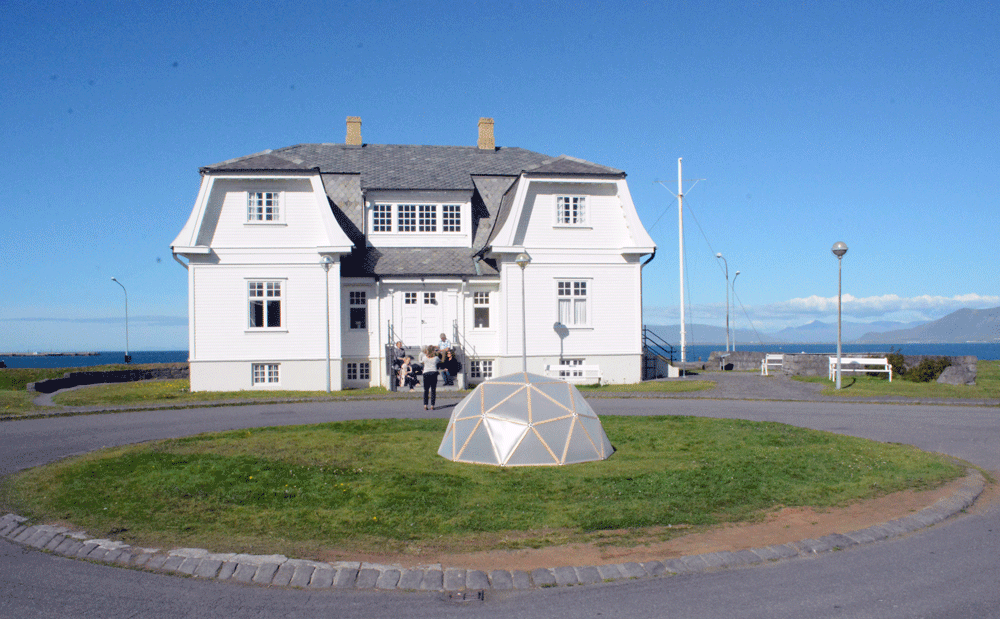
After our three weeks of work our small Dome was symbolically erected at Höfði in Reykjavik, the site of the 1986 Gorbachev-Reagan summit that presaged the unravelling of the Iron Curtain.
Next it is to be part of an exhibition at the international Relate North conference for artists and creative engagement to be hosted in Shetland in November 2016. Its triangles hold the stories of so many participants, from such a diversity places and perspectives. Yet it is the rich yet intangible network of relationships woven with people and places, knowledge gleaned and awareness raised, that is the real and powerful outcome of this journey of creative engagement.

Tuesday, 3 May 2016

Glasgow International 2016

Glasgow feels more like the wild west than Edinburgh, a wee bit more chaotic, more homeless folk on Argyll Street and around the station, more 'real life' around the centre. A good place for 'real art' then? Art that is tapped in to all this unpredictable energy, the legacy of an industrial past? 

The Glasgow International 2016 is Sarah McCrory’s curated programme, this year loosely themed around the ‘legacy of industry and the relationship artists have to making, production and craft’. Fittingly the class met up at GoMA, that elegant neoclassical building from 1778, once the townhouse for one of the city's unscrupulous tobacco lords. 

I'd already popped into a couple of the venues on the GI 2016 map. At the Briggait down by the Clyde Jack Mooney's  'Who are you and what do you want?' used luridly coloured plastic models of cake, double-headed beasts and other food of religious ritual in his work about 'the various ways in which various cultures celebrate, memorialise and represent death.' Deliberately grotesque - not the best thing before breakfast.. Other early morning memorables were Mari Hokkanen's 'Set & Settings' at the Street Level Photoworks. Her photographs are brightly coloured staged self-portraits that also play with the grotesque and the tacky, but in a much more tongue-in-cheek way than Rachel MacLean. In the next room I was attracted by Catrine Val's very different staged self-portraits within landscapes, telling the stories of forgotten female philosophers and their works. Nicholas Parry's mezzotint and mural show at the Glasgow Print Studio was a highlight; his finely-crafted intimate prints zinged against walls painted with graffiti-like marks and shapes in greys and whites. I loved the interplay of serious  print art (mezzotint is hard work!) and fun. Parry was once a graffiti artist.

Unexpectedly, after all this, GoMA itself felt a little flat. I simply couldn't get Cosima von Bonin's white plastic blow up and massive shag pile toys on any level, and I couldn't connect them with 'Who's exploiting Who in the deep sea'. But Tessa Lynch's installation about a city commute was a good collection of visual fragments, including woven brick wall and pinkish pavement slabs, of what appeared to have been a rather dull train ride. For me it really evoked the boredom and mental disconnect of the daily commute. 

It was a mad dash around the city for the rest of the two days. There was so much going on! While there was the usual mix of super clever, surreal and just plain obscure, there were some real stand outs. Monika Sosnowska, a Polish artist growing up in the post-Communist era, and observing the destruction of Communist architectural edifices, had work at the Modern Institute. The main piece was a huge tangle of black metal - bedstead or barbed wire? - occupying much of a large white space. The distortions and bends in the metal were startlingly beautiful, reminiscent of liquid reflections, belying their true solidity. I was struck by the eloquence of the piece - there seemed to be so many layers of emotional content. 

At the CCA Pilvi Takala, a Finnish artist, had a review of her work to date, with 10 videos of different social art and performance projects. She 'works with video documenting experimental performances that challenge silently agreed rules within particular communities of people'.  Although these were all thought-provoking, I remember most clearly the work 'Lost Pigeons', hundreds of posters with individually drawn, subtly different lost pigeons based on information from pigeon fanciers in Ghent. The piece is meant to 'offer insight into the economy of the pigeon sport.', but for me, and for many, I'm sure, it was a poignant reminder of all those 'lost' human lives in the urban jungle - some of whom I'd had just seen begging by Queen Street station...

Nearby in the Reid Building Serena Korda et al. had an eclectic installation 'Hold Fast, Stand Sure, I Scream a Revolution', resulting from a residency with Glasgow and Mull that links the feminist history of Garnethill with 'thin places' between worlds on Mull, and the role of psychedelic mushrooms in accessing those thin places. As a centrepiece to the exhibition the artist has created a field of porcelain mushrooms that can be played as bell, and has collaborated with sound designer Martin Low to work with a range of local people to perform with the bells at the exhibition preview. There appeared to have have been a strong element of social engagement in this work, which was not, of course, fully documented in the gallery space. 

In the end it was the Tramway south of the river that was the centrepiece of GI 2016. In a darkened space a beautifully-shot film by Amie Siegal, 'Provenance', charted the life of pieces of 'vintage' modernist furniture from the Indian city of Chandigarh, with its gradually eroding Le Corbusier architecture. The use of light, space, natural and human sound (and silence) throughout the piece, created for me something that was bigger and more expressive than its immediate socially-charged subject matter.

Martin Boyce had designed the space in the main gallery to accommodate the work of four artists. Laurence Lek's video installation QE3, using 'digital fabrication to construct a reimagining of the final voyage of the QE2…as it is converted by an anonymous Glaswegian artist into a new home for the Glasgow School of Art', was fun and clever in its technical mastery, but perhaps a slightly literal interpretation of the brief. Mika Rottenburg's deliberately dark and repulsive films about the inequities of world manufacture and trade explored the cultured pearl-making process through a female character whose nose grows, similar to the pearls, as the result of an induced an allergic reaction (Nonoseknows). 'Squeeze' about global outsourcing, includes a memorable image of a fat woman being squeezed in the same way that the blubbery white latex in a Kerala rubber plant is being processed. I couldn't watch too long as I was feart of being put off my lunch!

Sheila Hicks, the veteran textile artist (b.1934), had a monumental piece 'Mighty Mathilde and her Consort', composed of bags of brightly coloured textile fibres, recalling Glasgow's textile history and trade with the far East. That was eye-catching and truly physical. The textile piece I was most drawn to was Trolley I and Trolley II by Alexandra Bircken. These two frames of scaffolding on tramway wheels held woven pieces, recalling Glasgow's maritime industrial past. I loved the way the pieces worked in the space - solid and translucent, tough and fragile, creating textures and perspectives...  All in all, a really rewarding visit to the GI 2016.